
Understanding Single Tooth Implants and What They Can Do For Your Smile
Missing a tooth can affect more than just your smile—it can impact your confidence, ability to chew, and even your oral health. At Renew Dental, we offer single tooth implants in Winnipeg as a durable, natural-looking solution to help you restore your smile and protect your long-term dental health.
Our experienced team of dentists in Winnipeg, use advanced techniques and state-of-the-art technology to provide high-quality implant care in a welcoming, patient-focused environment.
What Are Single Tooth Implants?
Single tooth implants are a type of dental implant used to replace one missing or severely damaged tooth, restoring both the appearance and function of your natural smile. They are widely regarded as the gold standard in modern tooth replacement because of their durability, strength, and natural look.
Unlike traditional bridges or removable dentures, a single tooth implant replaces both the root and the visible part of the tooth, offering a permanent and highly functional solution.
Components of a Single Tooth Implant
A single tooth implant is made up of three key parts:
1. Implant Post (Fixture)
- A small titanium screw that is surgically placed into the jawbone.
- This serves as an artificial tooth root, providing a solid foundation for the crown.
- Titanium is biocompatible, meaning it naturally fuses with the bone in a process called osseointegration.
2. Abutment
- A connector piece placed on top of the implant post after it has healed and fused with the bone.
- The abutment extends above the gumline and provides the support for the dental crown.
3. Dental Crown
- A custom-made ceramic or porcelain cap that looks and feels like a natural tooth.
- Designed to match the color, shape, and size of your existing teeth for a seamless result.
What is a single tooth implant, and how does it differ from other tooth replacement options?
When we look at the other options, generally, in order to replace a tooth, we have two other options. Number one is a denture, usually a partial denture. This is an appliance that goes in and out of your mouth. It replaces the missing tooth by hooking around your other teeth with metal clasps and is usually used to replace multiple teeth.
The downside is that it is often bulky and uncomfortable to wear. Generally, it's not the best option and is usually only used when finances are a major concern because it is the cheapest replacement option.
The next option we have is what's called a dental bridge. A dental bridge is used when you have a missing tooth, and the two teeth on either side are shaved down so that a three-tooth appliance is made and cemented on those two outer teeth, replacing the one in the middle. This is more of a permanent option or a final option, meaning that it stays in your mouth and doesn't have to be removed. The downside is that it involves shaving down the two teeth on either side.
Once we start shaving those teeth, they can potentially have issues such as eventually needing a root canal or getting a cavity that forms around the bridge on those teeth. Generally, it's not a great option unless those two teeth are heavily damaged because they have a big cavity or have had previous large fillings due to cavities or chips. It's generally not the best option unless we're in that scenario.
The last option, which is the single tooth implant and is generally the best option, is essentially an artificial root that replaces the missing tooth. Then we have a crown that goes over top and attaches to that artificial root. The main reason why this is the best option is that it's usually the longest-lasting option. An implant, in best-case scenarios, could last the rest of your life.
The crowns on top generally last quite long as well, sometimes needing replacement once or twice over the years if things wear down or break. The other benefits are that it's the closest option to a natural tooth. It's the only option that actually goes in the bone and helps to hold the bone in place.
Once you lose a tooth, your body has no reason to hold that bone anymore, and over time, it starts to shrink. It's similar to if you go to the gym and lift weights. You build your muscles up, and then when you stop, they naturally start to shrink and go away. This is important because the bone holds all of our teeth in place and supports your facial structure. If you start losing a lot of bone, your face can start to shrink in, giving you a more aged appearance, or the teeth around that site can start shifting into that area, leading to misalignment or teeth coming out too far.
Another big factor is that when you're missing a tooth, all of our teeth work as a team. When I take one out, all my other ones automatically have to start working harder, leading to them wearing down, breaking, or cracking prematurely, which can lead to many other issues in the future.
Generally, at the consult, we assess the area where you're missing your tooth. We might take a 3D digital scan to assess that area. We also look at getting a 3D CBCT X-ray, a 3D X-ray that goes around your head, telling us exactly how much bone is available in the area and how much distance we have to any structures we may want to avoid.
From there, we work with a lab to plan your implant to ensure it goes into the best position possible, making it as natural as possible with the tooth on top. The second stage is the placement of the implant itself or the artificial root. That generally involves a single appointment that's about an hour and a half long. We numb up the area for you, make a little channel in that area, and then the implant itself goes in.
The Single Tooth Implant Process at Renew Dental
At Renew Dental, your care is our priority. Here’s what you can expect from the implant process:
1. Consultation and Treatment Planning
Your journey begins with a detailed consultation with a skilled dentist in Winnipeg. We’ll examine your teeth, review your medical history, take digital X-rays, and determine if bone grafting is necessary.
2. Implant Placement
Once you’re ready, the titanium implant post is surgically placed into your jawbone. We ensure minimal discomfort using local anesthesia and gentle techniques. Healing time typically takes a few months as the implant fuses with the bone (a process called osseointegration).
3. Abutment and Crown Placement
Once the implant has fully integrated, we’ll attach the abutment and then place a custom-made dental crown. The result is a secure, natural-looking tooth that functions just like your own.
4. Follow-up and Maintenance
We’ll schedule regular check-ups to ensure your implant remains healthy. With good oral hygiene and routine visits to your dentist in Winnipeg, your implant can last for decades.
Once the implant is in place, what does the tooth implant placement look like, and how long are those appointments typically?
Once the implant has been in the bone and everything has healed, which is generally about four months, we can then start proceeding with placing the actual crown on that implant. The placement of the crown is quite easy.
Generally, it's done in two appointments. The first one is an hour long, to take an impression or scan of that implant so we can send that to the lab to make the crown. The next visit involves simply trying on the crown, making any adjustments to ensure it fits properly, and screwing it in place so you can chew on it and use it as a normal tooth.
What is a bone graft for a dental implant, and when is it generally necessary?
A bone graft is needed when you've been missing that tooth, or it has been taken out, and you don't have enough bone in that area to surround the implant when it goes in.
An implant works because you have a good amount of bone that helps to hold it in place. If we don't have enough bone for that implant to go in, we need to build it up by doing a bone graft. This means placing new bone or particles of bone so that your body can heal around this and essentially grow bone in that area to allow the implant to be placed.
It's necessary when patients don't have enough bone, either because it's shrunk too much from the side or shrunk down too much, leaving not enough room for us to place the implant, so we have to build it up first.
How does a single tooth implant compare to a partial denture or a bridge?
As we discussed earlier, a single tooth implant is usually the closest option to feeling like a natural tooth. It doesn't involve the teeth on either side, doesn't affect those teeth, and you can still floss between it normally. It's pretty close to your natural tooth. A bridge will also feel pretty natural on your tongue, but one of the big problems is that because it's connected, you have to do special flossing underneath to prevent bacteria from growing there, which can cause cavities or gum disease. That would be the one major difference with the bridge.
For the partial denture, it's a significant difference because it sits on the outside of your teeth. Generally, we have to make it quite large because it's removable, and we don't want you to swallow it or aspirate it in a worst-case scenario. You will notice with your tongue that there is quite a bit of bulk to these appliances, and there is a learning curve to get used to it.
In general, when we look at the three options, patients usually find that single tooth implants are the most comfortable option and the one that requires the least amount of adjustment.
How can I find a qualified single-tooth implant dentist?
When it comes to implants, dentists generally have done additional training to be able to place implants, as it's usually not something they learn directly out of school. To determine if this is the right dentist for you or if you're comfortable with them doing your implant, you can ask if they've done any training, what type of training they've done, how many implants they've placed, and what their comfort level is with the procedure.
Having a conversation with them would usually be the best way to determine if you're comfortable with that dentist placing the implant for you. I think that's the best way to go about doing that.
What are the benefits of replacing a tooth with a single tooth implant?
A few of the biggest benefits are that you have that artificial root in the bone, which acts like all of your other teeth roots and helps to hold that bone in place to hopefully prevent bone loss over time. Other benefits include not affecting the teeth on either side, allowing you to continue flossing between the implant and the teeth to keep them healthy.
Another big benefit is restoring your teeth back to where they were, giving you a full set of teeth again so you can chew normally. This helps with chewing harder foods, such as steak, and supports your other teeth so they don't have to work too hard, reducing the risk of them wearing down prematurely, cracking, or breaking. It helps to support all the ones around them.
Another major benefit is that it acts as a placeholder so that your other teeth don't start moving into that area, going sideways, or the ones on the top start coming down because of a missing tooth on the bottom. When everything lines up straight, it works the way it should, reducing the risk of further issues, such as cracks or potentially breaking a tooth and losing another tooth down the road.
Lastly, it restores your teeth and looks pretty similar to a natural tooth. Especially if we're doing it in the front, there's a big cosmetic bonus as you're restoring your teeth, and it looks quite natural.
Benefits of Single Tooth Implants
Patients choose single tooth implants in Winnipeg for a wide range of reasons, including:
- Natural appearance and feel – Your implant crown is custom-designed to blend seamlessly with your surrounding teeth.
- Improved oral function – Chew, bite, and speak with confidence and comfort.
- Bone preservation – Implants stimulate the jawbone, helping to prevent bone loss.
- Long-term solution – With proper care, implants can last a lifetime.
- No impact on surrounding teeth – Unlike bridges, dental implants don’t require grinding down adjacent teeth.
When placed by a skilled dentist in Winnipeg, a single tooth implant can restore not only your appearance but also your oral health and quality of life.
How much is a single tooth implant going to cost?
This depends on the individual circumstances. It depends on whether you need a bone graft or tissue grafting, or if other things are needed along with the implant. Generally, when you're looking at an implant, you are looking at around $6,000 to replace the tooth.
At our office, we sometimes run specials or promotions to help the patient with getting that implant done. I would definitely recommend booking an exam so that we can evaluate your situation and discuss the finances involved at that time.
Are there significant cost differences between a single tooth implant and other tooth replacement options?
When it comes to the cost of a single tooth implant versus a bridge versus a partial denture, there are cost differences between these treatment options. I like to think about the higher initial investment in terms of the cost of the treatment, but also what I'm getting and how long I expect it to last. A lot of the time, with bridges or partial dentures, they have to be replaced more frequently than a single tooth implant. With a denture, for example, it usually has to be replaced every 6 to 7 years, and with a bridge, about every 10 to 15 years. Whereas an implant can last much longer. Even though I might spend more on the implant initially, it ends up costing less in the long run because I don't have to replace it. Also, there tend to be fewer complications with implants, meaning I don't have to do additional procedures that cost extra money.
Who Is a Good Candidate for a Single Tooth Implant?
You may be a good candidate for a single tooth implant if you:
- Are missing one tooth due to decay, trauma, or extraction
- Have sufficient jawbone density to support the implant
- Are in good overall and oral health
- Don’t smoke or are willing to quit during the healing process
- Are looking for a permanent, low-maintenance solution
If you’re unsure, our team at Renew Dental will perform a comprehensive evaluation to determine if single tooth implants in Winnipeg are right for you.
Schedule Your Consultation Today
If you’re considering single tooth implants in Winnipeg, let the trusted team at Renew Dental help you take the first step toward a healthier, more confident smile.
Don’t let a missing tooth hold you back. Contact your local dentist in Winnipeg today and discover the life-changing benefits of single tooth implants.
What Is Dental Implants?
Dental implants are titanium posts surgically placed into the jawbone to serve as artificial tooth roots, onto which a custom porcelain crown is attached to replace a missing tooth permanently. Unlike dentures or bridges, implants fuse directly with living bone through a process called osseointegration, providing a stable, natural-feeling replacement that preserves jaw structure and does not affect neighbouring teeth. For Winnipeg patients who have lost teeth to decay, injury, or gum disease, dental implants at Renew Dental offer the closest functional and aesthetic equivalent to a natural tooth available in modern dentistry.
6 Key Facts About Dental Implants in Winnipeg
- Implants are a permanent solution. With proper care, a dental implant and its crown can last 25 years or longer — often a lifetime — making them more cost-effective than dentures or bridges that require replacement every 7–15 years.
- The procedure involves multiple stages. After the implant post is placed, a healing period of 3–6 months allows osseointegration (bone fusion) before the final crown is attached. Temporary restorations are provided during this period.
- Most adults in good health qualify. Ideal candidates have adequate jawbone density, healthy gums, and no uncontrolled systemic diseases. A bone graft may be needed first if significant bone loss has occurred.
- Implants feel and function like real teeth. Unlike dentures, implants do not slip, click, or require adhesives. Patients can eat, speak, and smile with full confidence immediately after the final restoration is placed.
- Manitoba Health covers some implant-related procedures. While implants themselves are not covered under provincial health benefits, some related surgical procedures may qualify for partial coverage. Renew Dental provides detailed predetermination letters to maximize insurance reimbursement.
- Bone loss accelerates without replacement. Every month a tooth root is absent, the surrounding jawbone shrinks. Replacing a missing tooth with an implant within 6–12 months of extraction preserves facial structure and simplifies the procedure.
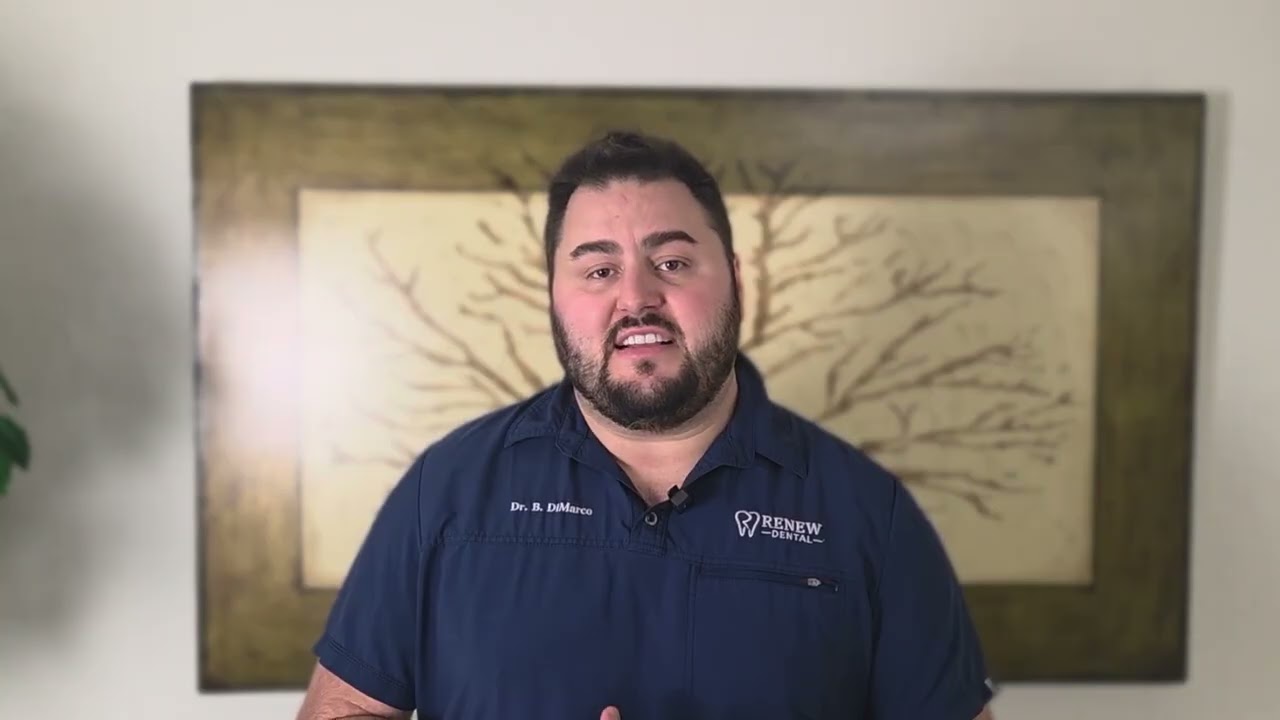
This page was reviewed by Dr. Bryan DiMarco DDS, owner and lead dentist at Renew Dental Winnipeg. Dr. DiMarco has over 10 years of experience in implant dentistry and restorative procedures, providing single-tooth implants and implant-supported restoration solutions for patients throughout the Bridgwater and Waverley West communities.
Frequently Asked Questions About Dental Implants in Winnipeg
How much do dental implants cost in Winnipeg?
A single dental implant in Winnipeg typically costs between $3,000 and $5,500, which includes the implant post, abutment, and crown. The final cost depends on whether bone grafting or other preparatory procedures are needed, the materials used for the crown, and your specific case complexity. At Renew Dental, we provide a detailed cost breakdown after a thorough assessment. Call (204) 817-6768 to schedule a consultation at our Winnipeg clinic at 405 Centre St, Unit 1.
How long do dental implants last?
Dental implants are the most durable tooth replacement option available. The titanium implant post, which fuses with your jawbone, can last a lifetime with proper care. The implant crown (the visible tooth portion) typically lasts 10 to 20 years before it may need replacement due to normal wear. With good oral hygiene, regular dental check-ups at Renew Dental, and avoiding habits like grinding or chewing hard objects, most patients enjoy their implants for decades.
Am I a good candidate for dental implants?
Most healthy adults with good bone density and healthy gums are candidates for dental implants. Ideal candidates are non-smokers or willing to quit (smoking significantly reduces implant success rates), have no uncontrolled diabetes, and have sufficient jawbone to support the implant. Patients with bone loss may still be candidates after bone grafting. At Renew Dental in Winnipeg, we use digital X-rays and a thorough clinical exam to assess your suitability during a consultation.
Does getting a dental implant hurt?
The implant placement procedure is performed under local anaesthesia, so you should feel little to no pain during the surgery. Many patients report that the procedure is more comfortable than they expected. After the anaesthesia wears off, you may experience mild soreness, swelling, and bruising for a few days, which is manageable with over-the-counter pain relief. Renew Dental's team will provide detailed aftercare instructions and is available to answer any questions during your recovery.
How long does the dental implant process take?
The full dental implant process at Renew Dental in Winnipeg typically takes 3 to 9 months from start to finish. After the implant post is placed, it requires a healing period of 3 to 6 months for osseointegration (fusing with the jawbone) before the permanent crown is attached. If bone grafting is needed, it can add additional healing time. We will give you a personalised timeline during your initial consultation so you know exactly what to expect.
Does Manitoba Health cover dental implants?
Manitoba Health (provincial health insurance) generally does not cover dental implants as they are considered an elective procedure. However, many private dental insurance plans provide partial coverage for implant-related components such as the crown or pre-surgical procedures. We recommend checking your specific plan details. Renew Dental can provide a predetermination letter for your insurer. We also discuss flexible payment options to help make implants accessible for our Winnipeg patients.
What is the success rate of dental implants?
Dental implants have an impressive long-term success rate of 95% to 98% over 10 years in healthy patients. Success depends on proper patient selection, meticulous surgical technique, and diligent aftercare. Risk factors that can reduce success include smoking, uncontrolled diabetes, poor oral hygiene, and insufficient bone volume. At Renew Dental, we carefully evaluate every patient to optimise outcomes and provide thorough post-operative guidance.
How do I care for a dental implant?
Caring for a dental implant is similar to caring for a natural tooth. Brush twice daily with a soft-bristled toothbrush, floss daily (including around the implant), and use a non-abrasive toothpaste. Avoid chewing ice, hard candies, or using your teeth as tools. Visit Renew Dental at 405 Centre St, Winnipeg for regular check-ups and professional cleanings. Routine dental visits allow us to monitor the implant's health and catch any issues early.